


Awakening the Throat Chakra: Exploring the Vishuddhi Chakra
- Apr 5, 2024
- 2 min read
At the base of the throat lies the Vishuddhi Chakra — in tradition, the energy centre of self-expression, communication, and inner truth. Represented by a vibrant blue, it's seen as the gateway to authentic expression, aligning our thoughts, words, and actions.
Of all the chakras, this is the one most naturally connected to sound — it governs the voice itself. At Ananda Dhwani, where the voice is one of our core instruments, the throat chakra is close to the heart of the practice. This guide explores what Vishuddhi represents in tradition, and how sound — especially your own voice — can help open and balance it.
The Vishuddhi Chakra: An Overview
In Sanskrit, Vishuddhi translates to "purification" or "pure" — reflecting the throat chakra as a space of clarity. As the fifth chakra, it's associated with self-expression, communication, and the integration of our inner and outer worlds, governing our ability to articulate our thoughts, speak our truth, and listen attentively.
When it feels balanced, tradition holds, we express ourselves clearly, honestly, and with ease.
Signs of an Imbalanced Throat Chakra
In traditional understanding, imbalance can show up in two directions:
● Underactive: difficulty expressing yourself, fear of speaking up, or a lack of confidence in your own voice.
● Overactive: talking over others, difficulty listening, or dominating conversations.
Treat this as a traditional lens for gentle reflection — not a diagnosis.
Balancing the Throat Chakra with Sound
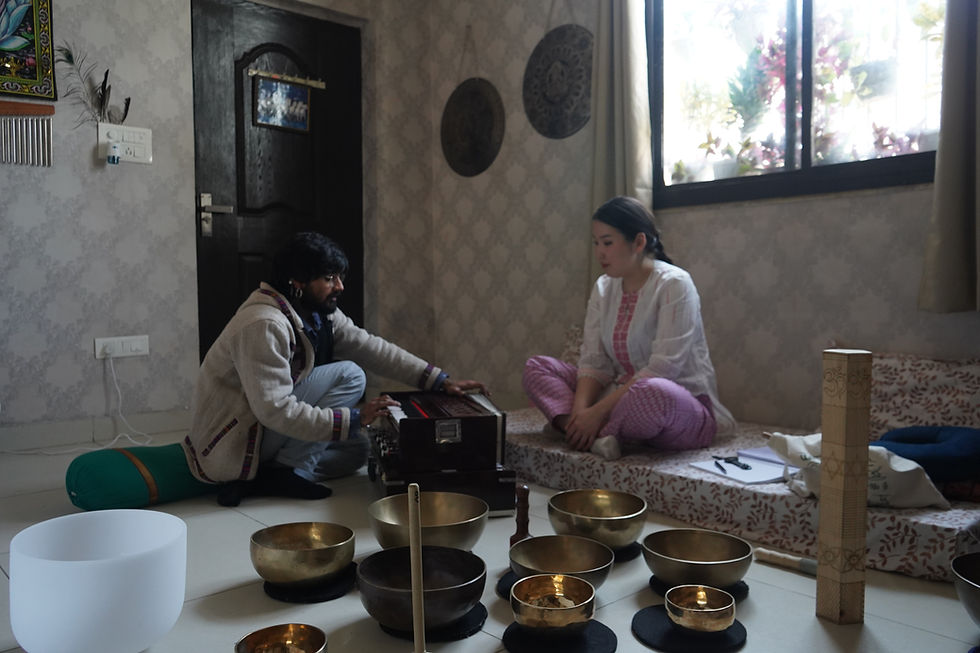
This is the chakra where sound truly comes into its own. In sound healing tradition, the throat is associated with particular tones (often the note G), and — uniquely — with your own voice:
● Vocal toning and chanting — the seed (bija) mantra traditionally linked to this chakra is "Ham," and chanting "OM" or humming creates vibration right at the throat. This is the single most direct practice for this centre. (See our guide to [voice toning, chanting, and overtoning].)
● Singing bowls and tuning forks tuned to the throat frequency, played near the throat, to invite a sense of openness and ease.
● Sound baths, which many people find help release the tension we hold around expressing ourselves. (See our guide to [the 7 chakra frequencies].)
Simple Daily Practices
Alongside sound, a few gentle practices support this centre:
● Conscious communication — pausing before speaking, listening attentively, letting your words match your intentions.
● Journaling — writing freely, without judgment, to let your true voice emerge.
● Creative expression — singing, writing, or any outlet that lets you express yourself authentically.
● Meditation — resting attention at the throat, visualising a soft blue glow.
● Affirmations — "I express myself clearly and truthfully," "My voice matters."
These are gentle wellbeing practices, and a lovely complement to — never a replacement for — professional support where it's needed.
Find Your Voice with Ananda Dhwani
If you'd like to learn to work with the chakras through sound — and to use your own voice as an instrument — our [5-Day In-Person Sound Healing Teacher Training in Rishikesh] teaches chakra sound work and vocal practice hands-on, with a full range of instruments and frequencies.
Through the throat chakra, tradition invites us to speak, sing, and sound our truth. Let your voice be heard. 💙


Comments